Greetings on the occasion of the 59th anniversary of the attack on the Moncada Barracks
Long live July 26!
Today is the 59th anniversary of the attack on the Moncada Barracks
in Santiago, Cuba, and thus is a fitting occasion to remind ourselves of
what we all owe to the Cuban Revolution.
On July 26, 1953, 140 Cuban patriots stormed the heavens by
launching an armed attack on the Moncada Barracks in Santiago, Cuba, in
an effort to spark a national uprising to overthrow the odious U.S.
supported military dictator, Fulgencio Batista. The attack failed, and
many of the patriots became martyrs to their cause, either dying in the
fighting or being murdered by Batista's agents in the aftermath. Only
because of a national and international pressure campaign were comrades
Fidel Castro and Raul Castro amnestied.
The Cuban revolutionaries did not give up, but continued to prepare,
within Cuba and from exile, the campaign that eventually ousted
Batista on January 1, 1959.
Quickly, Cuban reactionaries and their imperialist allies rallied to
try to reverse the verdict expressed by the Cuban people on that date.
They tried everything, and continue to do so: Invasions, sabotage,
terrorism and assassination, economic strangulation and a vast
propaganda campaign designed to dislodge the Cuban Revolution and
subject the people of Cuba once again to class oppression and
imperialist subjugation.
However Cuba has prevailed, even when the collapse of socialism in
the Soviet Union and Eastern Europe struck it such a dangerous blow.
In Cuba, the Revolution has created a better life for working people
and the masses. Internationally, the gift of the Cuban Revolution has
included.
The end of the odious apartheid regime in South Africa.
The renovation of the revolutionary movements in Latin America and beyond.
The renovation of the communist and workers' parties worldwide, who have learned, by Cuba's example, that a commitment to socialism does not entail adherence to ossified dogmas and bureaucratic, top down methods.
The development of the critique of late imperialism and of neo-liberal economic policies, as well as the strategy for combating them through popular mobilization.
The increasing unity of Latin America and ultimately of all the poor countries of Asia, Africa and Latin America behind a broad program of progressive change.
The disinterested provision of high quality health care, education and other services to poor countries around the world.
Fifty nine years on, however, imperialism has not given up its idea
of reversing the Cuban Revolution. Although there have been some changes
in the last couple of years, the United States still maintains the
economic blockade of Cuba, and continues to imprison, in the face of
worldwide indignation and pressure, four of the "Cuban Five" heroes.
U.S. government funds still support propaganda and destabilization
efforts.
So the struggle goes on, for Cuba and for Cuba's friends around the world, including here in the United States.
The Communist Party of the USA hereby:
Salutes the Cuban Communist Party and the Cuban people on the occasion of the 59th Anniversary of the Attack on the Moncada Barracks.
Sends our special greeting to comrades Fidel Castro Ruz and comrade president Raul Castro Ruz, thanking them for their long service to the international working class and humanity, and wishing them many more years of good health and happiness.
Recalls to memory the glorious members of the first generation of the Cuban Revolution who are no longer with us physically but whose names will live for ever, including especially comrade Ernesto "Che" Guevara and so many others.
Pledges ourselves to keep struggling to end the blocade and travel restrictions, to put a stop to all harassment and destabilization activities directed against Cuba, and to free the Cuban Five.
YouTube vlogger 24EvelJustin24 recently gave a no-holds barred assessment of the recent AP article reporting that poverty in the US is rising to the highest levels since 1960. The Working Class need more people willing to speak out and boldly say what needs to be said. The article referred to is reposted below the video. - Lupus
**********************************
***********************************
U.S. Poverty On Track To Rise To Highest Since 1960s
By HOPE YEN
07/22/12 05:47 PM ET
WASHINGTON — The ranks of America's poor are on track to climb to
levels unseen in nearly half a century, erasing gains from the war on
poverty in the 1960s amid a weak economy and fraying government safety
net.
Census figures for 2011 will be released this fall in the critical weeks ahead of the November elections.
The Associated Press surveyed more than a dozen economists,
think tanks and academics, both nonpartisan and those with known liberal
or conservative leanings, and found a broad consensus: The official
poverty rate will rise from 15.1 percent in 2010, climbing as high as
15.7 percent. Several predicted a more modest gain, but even a 0.1
percentage point increase would put poverty at the highest level since
1965.
Poverty is spreading at record levels across many groups, from
underemployed workers and suburban families to the poorest poor. More
discouraged workers are giving up on the job market, leaving them
vulnerable as unemployment aid begins to run out. Suburbs are seeing
increases in poverty, including in such political battlegrounds as
Colorado, Florida and Nevada, where voters are coping with a new norm of
living hand to mouth.
"I grew up going to Hawaii every summer. Now I'm here, applying for
assistance because it's hard to make ends meet. It's very hard to
adjust," said Laura Fritz, 27, of Wheat Ridge, Colo., describing her
slide from rich to poor as she filled out aid forms at a county center.
Since 2000, large swaths of Jefferson County just outside Denver have
seen poverty nearly double.
Fritz says she grew up wealthy in the Denver suburb of Highlands
Ranch, but fortunes turned after her parents lost a significant amount
of money in the housing bust. Stuck in a half-million dollar house, her
parents began living off food stamps and Fritz's college money
evaporated. She tried joining the Army but was injured during basic
training.
Now she's living on disability, with an infant daughter and a
boyfriend, Garrett Goudeseune, 25, who can't find work as a landscaper.
They are struggling to pay their $650 rent on his unemployment checks
and don't know how they would get by without the extra help as they hope
for the job market to improve.
In an election year dominated by discussion of the middle class,
Fritz's case highlights a dim reality for the growing group in poverty.
Millions could fall through the cracks as government aid from
unemployment insurance, Medicaid, welfare and food stamps diminishes.
"The issues aren't just with public benefits. We have some deep
problems in the economy," said Peter Edelman, director of the Georgetown
Center on Poverty, Inequality and Public Policy.
He
pointed to the recent recession but also longer-term changes in the
economy such as globalization, automation, outsourcing, immigration, and
less unionization that have pushed median household income lower. Even
after strong economic growth in the 1990s, poverty never fell below a
1973 low of 11.1 percent. That low point came after President Lyndon
Johnson's war on poverty, launched in 1964, that created Medicaid,
Medicare and other social welfare programs.
"I'm reluctant to say that we've gone back to where we were in the
1960s. The programs we enacted make a big difference. The problem is
that the tidal wave of low-wage jobs is dragging us down and the wage
problem is not going to go away anytime soon," Edelman said.
Stacey Mazer of the National Association of State Budget Officers
said states will be watching for poverty increases when figures are
released in September as they make decisions about the Medicaid
expansion. Most states generally assume poverty levels will hold mostly
steady and they will hesitate if the findings show otherwise. "It's a
constant tension in the budget," she said.
The predictions for 2011 are based on separate AP interviews,
supplemented with research on suburban poverty from Alan Berube of the
Brookings Institution and an analysis of federal spending by the
Congressional Research Service and Elise Gould of the Economic Policy
Institute.
The analysts' estimates suggest that some 47 million people in the
U.S., or 1 in 6, were poor last year. An increase of one-tenth of a
percentage point to 15.2 percent would tie the 1983 rate, the highest
since 1965. The highest level on record was 22.4 percent in 1959, when
the government began calculating poverty figures.
Poverty is closely tied to joblessness. While the unemployment rate
improved from 9.6 percent in 2010 to 8.9 percent in 2011, the
employment-population ratio remained largely unchanged, meaning many
discouraged workers simply stopped looking for work. Food stamp rolls,
another indicator of poverty, also grew.
Demographers also say:
_Poverty will remain above the pre-recession level of 12.5 percent
for many more years. Several predicted that peak poverty levels – 15
percent to 16 percent – will last at least until 2014, due to expiring
unemployment benefits, a jobless rate persistently above 6 percent and
weak wage growth.
_Suburban poverty, already at a record level of 11.8 percent, will increase again in 2011.
_Part-time or underemployed workers, who saw a record 15 percent poverty in 2010, will rise to a new high.
_Poverty among people 65 and older will remain at historically low levels, buoyed by Social Security cash payments.
_Child poverty will increase from its 22 percent level in 2010.
Analysts also believe that the poorest poor, defined as those at 50
percent or less of the poverty level, will remain near its peak level of
6.7 percent.
"I've always been the guy who could find a job. Now I'm not," said
Dale Szymanski, 56, a Teamsters Union forklift operator and convention
hand who lives outside Las Vegas in Clark County. In a state where
unemployment ranks highest in the nation, the Las Vegas suburbs have
seen a particularly rapid increase in poverty from 9.7 percent in 2007
to 14.7 percent.
Szymanski, who moved from Wisconsin in 2000, said he used to make a
decent living of more than $40,000 a year but now doesn't work enough
hours to qualify for union health care. He changed apartments several
months ago and sold his aging 2001 Chrysler Sebring in April to pay
expenses.
"You keep thinking it's going to turn around. But I'm stuck," he said.
The 2010 poverty level was $22,314 for a family of four, and $11,139
for an individual, based on an official government calculation that
includes only cash income, before tax deductions. It excludes capital
gains or accumulated wealth, such as home ownership, as well as noncash
aid such as food stamps and tax credits, which were expanded
substantially under President Barack Obama's stimulus package.
An additional 9 million people in 2010 would have been counted above
the poverty line if food stamps and tax credits were taken into account.
Robert Rector, a senior research fellow at the conservative Heritage
Foundation, believes the social safety net has worked and it is now time
to cut back. He worries that advocates may use a rising poverty rate to
justify additional spending on the poor, when in fact, he says, many
live in decent-size homes, drive cars and own wide-screen TVs.
A new census measure accounts for noncash aid, but that supplemental
poverty figure isn't expected to be released until after the November
election. Since that measure is relatively new, the official rate
remains the best gauge of year-to-year changes in poverty dating back to
1959.
Few people advocate cuts in anti-poverty programs. Roughly 79 percent
of Americans think the gap between rich and poor has grown in the past
two decades, according to a Public Religion Research Institute/RNS
Religion News survey from November 2011. The same poll found that about
67 percent oppose "cutting federal funding for social programs that help
the poor" to help reduce the budget deficit.
Outside of Medicaid, federal spending on major low-income assistance
programs such as food stamps, disability aid and tax credits have been
mostly flat at roughly 1.5 percent of the gross domestic product from
1975 to the 1990s. Spending spiked higher to 2.3 percent of GDP after
Obama's stimulus program in 2009 temporarily expanded unemployment
insurance and tax credits for the poor.
The U.S. safety net may soon offer little comfort to people such as
Jose Gorrin, 52, who lives in the western Miami suburb of Hialeah
Gardens. Arriving from Cuba in 1980, he was able to earn a decent living
as a plumber for years, providing for his children and ex-wife. But
things turned sour in 2007 and in the past two years he has barely
worked, surviving on the occasional odd job.
His unemployment aid has run out, and he's too young to draw Social Security.
Holding a paper bag of still-warm bread he'd just bought for lunch,
Gorrin said he hasn't decided whom he'll vote for in November,
expressing little confidence the presidential candidates can solve the
nation's economic problems. "They all promise to help when they're
candidates," Gorrin said, adding, "I hope things turn around. I already
left Cuba. I don't know where else I can go."
___
Associated Press writers Kristen Wyatt in Lakewood, Colo., Ken Ritter
and Michelle Rindels in Las Vegas, Laura Wides-Munoz in Miami and AP
Deputy Director of Polling Jennifer Agiesta contributed to this report.
**Spoiler alert: This review is full of spoilers**
Director Chris Nolan calls it a “revolutionary epic.” I’d call it a counter-revolutionary blockbuster.
First, let’s get the obvious out of the way: The Dark Knight Rises
is an outstanding film visually, and it’s scintillating to watch on the
big screen. Christopher Nolan did not disappoint in delivering an
action-packed superhero tour-de-force like the previous two Batman
films. He tied the first two installments together to complete a complex
and compelling story. And most impressive of all, in my opinion,
series-newcomer Anne Hathaway’s role as Catwoman is one of the best
performances of the year.
But when I left The Dark Knight Rises at nearly 3:00 a.m. on its opening night, my opinion of the film was decidedly more mixed than my reaction to The Dark Knight four years ago. Sure, after you cut through Heath Ledger’s incredible performance and the mind-blowing special effects, The Dark Knight
was an insidious defense of the Bush administration’s war on terror,
interestingly timed right before the 2008 election. However, I didn’t
pick up on Nolan’s profoundly reactionary worldview when I saw that
second Batman film in the summer between high school and college. This
time around – after four years of activism, witnessing the rise of both
the Occupy Wall Street and the Tea Party movements and seeing the
widespread disappointment with President Obama – I couldn’t think of
much else.
In The Dark Knight [2008], Bruce Wayne (Christian Bale),
part-time CEO and full-time vigilante, faces off against a villain so
one-dimensional and disturbing he could have starred on a Dateline NBC
crime special. Heath Ledger’s brilliant performance as the Joker
overshadowed how closely his character mirrored the classic image of
terrorists painted by the Bush administration for eight years (“Some men
just want to watch the world burn”), with no discernible reasons or
motivations for their actions. To protect us from the Joker, Batman
takes it on himself to begin torturing prisoners, wiretapping civilians’
cell phones, and lying to the people of Gotham, all ‘for their
protection.’ When Harvey Dent (Aaron Eckhardt), the tough-on-crime
district attorney, becomes a madman and starts offing citizens, Batman
subdues him and colludes with Commissioner Gordon (Gary Oldman) to take
the fall for Dent’s crimes. We are told in the first scene of Nolan’s
new film that this lie allowed Gotham to pass the Harvey Dent Act, which
reduced crime by simultaneously reducing civil liberties. Sounds like a
fair trade, right Mr. Bush?
The Dark Knight Rises starts eight years later. Wayne is
older, partially crippled and reclusive, having retired from the outside
world after the death of his childhood love, Rachel Dawes (Maggie
Gyllenhaal) in the last movie. Bane (Tom Hardy), a muscular
insurrectionist clad in a bulletproof vest and a breathing mask lifted
from the Predator movies, shows up in Gotham to bring down the
city with a nuclear bomb. By the time Bane gets around to breaking
Batman’s back and explaining his master plan – trick the people of
Gotham into revolution and then exterminate them – one has to think,
“Wait, what?”
It didn’t surprise me that Nolan created a film about class warfare,
especially given the times we live in. What surprised me was the side he
decided to take. The Dark Knight Rises is a film extolling the
virtues of the 1% that tries to explain why working people can’t run
society and why a fascist police state is actually a good idea.
In The Dark Knight Rises, the rich have it just as bad as,
if not worse, than the rest of us. They lose their entire corporate
fortunes – inherited, in the case of Bruce Wayne, or stolen from an
unnamed West African country in the case of corporate rival Daggert – to
terrorist raids on the stock exchange. They have their homes
burglarized by the 99%, first by maids and later by angry anonymous
mobs. They lose their cleaning staff and butlers, forcing them to
(gasp!) open the front door themselves. The power company even turns off
their electricity. Forget flying billionaires dressed as bats; this is
the most unrealistic part of the movie.
In an early scene featuring Bane taking the entire Gotham Stock
Exchange hostage, a CEO stands nervously outside pressuring the police
to breach the door and secure the premises. “It’s not just my money,” he
complains. “It’s everyone’s money!” A skeptical police officer tells
him he keeps his money under a mattress at home, to which the CEO
replies – and I paraphrase – If we don’t stop them, your money under
that mattress will be worth a lot less.
Here’s a film so blissfully out of touch with the lives of working
Americans that it actually tries to make the argument that poor people
should be concerned about the fortunes of Wall Street bankers. Nowhere
in this film – or any of Nolan’s films, for that matter – is there any
attempt to look at the social roots of crime. What about Wayne
Enterprises’ bad investment decisions that cost workers their jobs or
pensions? Zilch. How about the jobs lost from corporate outsourcing to
neo-colonies in West Africa, explicitly referenced by one CEO in the
film? Eh, whatever. What about the steady decline of wages that
corporations like Bruce Wayne’s have encouraged for the past three
decades? Forget about it! Frankly, Nolan should have directed Romney’s
campaign commercials. The former governor certainly has the budget for
it in the wake of Citizens United!
The Dark Knight Rises is Hollywood’s rebuke of the Occupy
Wall Street Movement and the growing discontent with the market system
increasingly felt by working Americans. In Nolan’s universe, there’s no
difference between protest and terrorism. Ironically, in a world of
Obama’s ‘kill list’ and the National Defense Authorization Act, this may
be the most realistic aspect of his film.
The masses have no will of their own in Nolan’s series. They are an
object to either be manipulated by Bane or saved by Batman. Outlandish
scenes of the impoverished masses of Gotham vandalizing mansions and
beating up rich people for seemingly no reason reflects the Burkean
worldview that informed the founding fathers, the corporate leaders of
today and indeed Nolan himself. In the film, the people hold haphazard
‘sentencing tribunals’ with no due process for the wealthy, resulting in
sentences of ‘exile’ or ‘death by exile.’ It’s the German Peasant
Revolt. It’s the Paris Commune. It’s Occupy Wall Street. It’s every
popular movement in history that has ever challenged the will of the
ruling class.
Much has been said about the coincidence between the villain’s name,
Bane, and the financial management company owned and operated by
Republican presidential candidate Mitt Romney, Bain Capital. In truth, The Dark Knight Rises
more closely reflects Romney’s worldview than that of progressives. In a
pivotal scene, Bane confesses to an injured Bruce Wayne that he only
intends to ‘inspire hope’ to placate the people while he prepares to
exterminate them all. By the time Bane cynically talks about ‘hope’ for
the third time, I began wondering if Nolan was giving us a window into
the worldview of the world’s most obnoxious, Kool-Aid-drinking, Tea
Party scrub – a foreign, charismatic leader promises change to the
people while secretly conspiring to destroy them all from within. Bane
is a terrorist, not a revolutionary, but Nolan never seems to
distinguish between the two.
The film couldn’t be any clearer with its worldview. The main villain
is a charismatic atheisto-jihadist from a former Soviet Republic. His
army of ‘terrorists’ are cement-layers, linemen, bridge operators,
service employees; in other words, working-class people. His reserve
troops are freed prison inmates, many who undoubtedly were only serving
sentences because of the Big Brother-provisions of the Harvey Dent Act.
His shock troops are the unwashed masses of Gotham, who are too busy
engaging in wanton acts of anarchic violence and vandalism to realize
that they were duped by Bane. By the time la revolucion starts
up in the film’s third act, it’s impossible to distinguish between
Bane’s League of Shadows cadre, the prisoners they freed from Gotham’s
prison and ordinary working people in Gotham caught up in the uprising.
On the other hand, we have a slate of heroes straight out of a Glenn
Beck novel: an eccentric billionaire recluse who becomes a vigilante to
save the wayward people of Gotham from themselves; a police commissioner
who lies to the people to preserve ‘order’; a petty cat-burglar who
only becomes a hero by renouncing class warfare and hooking up with the
lead male; and an incorruptible rookie cop whose Boy Scout-demeanor
would make Captain America blush. Bane may have a mob army, but Batman
has an army of cops, who march into battle to put down the
malevolent…people of Gotham?
In the same year of Trayvon Martin’s shooting by a self-appointed
vigilante, the ensuing police cover-up and countless instances of police
brutality taking place every day, The Dark Knight Rises’
glorification of police militarism seems bizarre, if not sinister.
Similarly, Nolan’s final Batman film and its condemnation of mass
political action comes amidst mass uprisings across the Arab world,
Europe, Latin America, Africa and even the United States. Maybe Nolan
had an agenda, or maybe he didn’t. The point is that a film as
anticipated and publicized as The Dark Knight Rises pushes a very particular world view at odds with working Americans and oppressed people.
The message of The Dark Knight Rises is clear: Today’s
discontent underclasses are tomorrow’s insurgent army, and all it takes
is one charismatic leader to dupe the masses into suicide and
destruction. The people need to be ruled by a powerful class of
benevolent one-percenters. Lying and violating constitutional rights to
‘clean up the streets’ is generally justifiable. And above all else,
never let the people take power.
Even as an activist, you can enjoy The Dark Knight Rises as a
film. I certainly did. It’s important, though, that any and every
activist combats the worldview and message put forward by Nolan, which
itself reflects the larger trend of criminalizing dissent and protest in
this country. All too often, protesters are portrayed in the media as
parasites, criminals, degenerates, or terrorists for raising serious
concerns about inequalities and injustices in our society.
I left the film last night satisfied as a movie-goer and more riled
up than ever to fight the criminalization of protest and dissent in this
country. Nolan’s film made me remember the words of a famous
revolutionary: “It is right to rebel.”
Indeed it is.
“An individual who breaks a law that conscience tells him is
unjust, and who willingly accepts the penalty…in order to arouse the conscience
of the community over its injustice, is in reality expressing the highest
respect for the law”
― Martin Luther King Jr.
On November 2, 2011, I and a group of 13 others stood on a
small strip of grass in downtown Tulsa, Oklahoma, refusing the orders to leave
the park being barked over bullhorn while being surrounded by more than 50
officers leveling riot suppression weapons at us, and were arrested, taken
downtown, and booked in jail. I came back to the park the next night, and the
night after that, for over 2 weeks, receiving two more citations, and facing
off with the boys in blue each night as we sang the national anthem, union
songs, and recited passages from the bill of rights, Martin Luther King Jr., and OWS’ Declaration
of Occupation.I watched fellow
protesters being sprayed in the face at point blank range with pepper spray for
doing nothing more than sitting peacefully in protest, and I suffered minor
nerve damage which still occasionally flares up every so often from the
excessively tight zip cords they bound my hands with as they carried me away. I
stood before city council the night after I was released from jail to plead for
our rights only to be immediately shut down. I stood in the cold, in the rain
and sleet, shoulder to shoulder with other compatriots, facing the full and
terrible force of a belligerent militarized police force suppressing civil
liberties, and I would gladly do it again.
Why did I risk my liberty and freedom to stand on a strip of
grass after 11:01 pm? I did it because I believed, and still do, that the
freedoms our country supposedly stands for is an illusion. True democracy does
not exist – elections are rigged and controlled by wealthy corporate elites who
use politicians as puppets to expand their profits and strip workers and
citizens of their rights. Free speech is only free to those who can pay for it.
All but the wealthiest who can hire an army of attorneys are subject to
unreasonable search and seizure. Our civil and human rights are trampled on a
daily basis, and yet we take it, day in and day out. We fly our flags and vote
at election time, and unless we are directly bearing the brunt of injustice, we
tend to turn a blind eye to the outrages against justice that are meted out on
the poor, the minorities, and the plain unlucky.
I stood on that grass after curfew, in direct violation of a
law which requires legal bribery by the payment of outrageous fees and
insurance bonds to circumvent, a law which is designed to abridge citizen’s
rights of free speech unless they have enough money to pay to get around it,
and I made a stand. I could have moved two feet over to the sidewalk and
completely avoided violating the law, but I chose to break it as a direct act
of civil disobedience.
So I pled “No Contest” and was convicted of three
misdemeanor counts of breaking park curfew, and given a fine, which the judge
graciously reduced on account of being improperly represented at the beginning
(a problem which I remedied by hiring a very able and competent attorney). I
could have chosen to fight the charges as I’m sure some of the others arrested
that night - and the night before and the nights of the two weeks which
followed - might do. But to me, it is illogical and dishonest to commit an act
of civil disobedience and then try to plead innocent. I freely acknowledge that
I broke the law, and I have paid the price. The price however, is minuscule
compared to the toll which is exacted upon the people in the name of freedom.
Many more acts, and many more sacrifices will have to be made to balance back
the scales of justice in our favor.
Re-posted from Selecting Stones
by L. W. Denton
Yesterday marked the 100th anniversary of the birth of legendary folk
musician Woody Guthrie in Okemah, Oklahoma. Guthrie has long been a
controversial figure in Oklahoma and elsewhere for the simple reason
that he was a communist.
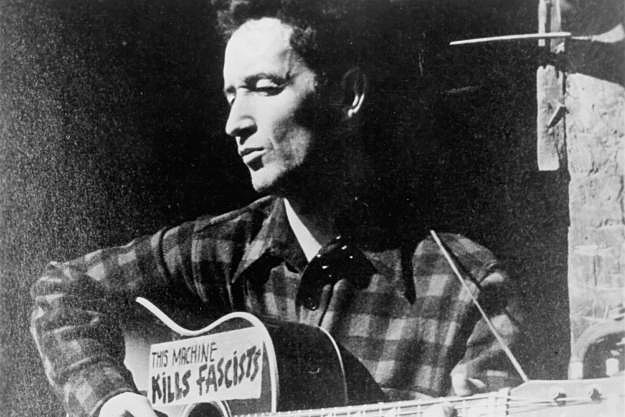
Woody Guthrie with his Guitar:
“This Machine Kills Fascists”
Woody Guthrie is most famous for two things: First, that he wrote the
song “This Land is Your Land”, and second, that he once said, “The best
thing that I did in 1936 was to sign up with the Communist Party.” It
is widely known that Guthrie was exaggerating with the words “sign up”,
as he was not a full member of the Communist Party. However, he did
work with the Communist Party extensively, writing regularly for The Daily Worker. No wonder, then, that today’s direct descendant of the old Daily Worker, the People’s World, ran an article yesterday on Okemah’s most famous Marxist son. Another indirect scion of the Daily Worker, the Oklahoma Workers’ Monthly, took a moment
to celebrate Woody Guthrie, too. And even though over the past 50
years “This Land is Your Land” has been stolen by right-wing
nationalists and mistaken for a celebration of American chauvinism, the
original version of the song penned by Guthrie makes its Marxist
viewpoint loud and clear. A verse that is always omitted today shows
that Guthrie proudly stood, as any communist would, for the ultimate abolition of private property:
“As I went walking, I saw a sign there,
And on the sign there, it said ‘Private Property’
But on the other side, it didn’t say nothing!
That side was made for you and me.”
Fascists, of course, have always stood for Private Property every bit
as much as anti-Semitism or anything else, and so it makes sense why
Guthrie would use his guitar as a machine to kill them.
Again, it seems today that everyone misses the original point of
“This Land is Your Land”. After all, most of us have been indoctrinated
since the third grade to believe that the song is sending the same
message as “God Bless America” when it is, in fact, doing quite the
opposite. The tragic fate of the song, however, serves to demonstrate
the greater tragic fate of Woody Guthrie’s legacy as a whole. No doubt
Woody is rolling in his grave at a large part of the way he is received
today. As a deeply political man, Guthrie would surely be upset to know
that his politics have been essentially whitewashed out of his life’s
story.
Each year since 1998, the town of Okemah has hosted the Woody Guthrie Folk Festival. The event’s website is careful not to mention anything political. In the recollection of Woody Guthrie’s life story, it seems that in reality everyone knows he was a communist. But in order to make Guthrie an “acceptable” figure, history has been rewritten to deny
Guthrie’s communism, or simply not talk about the issue. There is a
huge elephant in the room, and everyone prefers to stay quiet. An
Oklahoma entertainment monthly, The Current, recently ran an article
on this year’s milestone WoodyFest in Okemah. Since the event
coincides this year with Guthrie’s centenary, the article — by Dale Ann
Deffer — took the time to include a lengthy biographical sketch. Deffer
mentions over and over again that Guthrie passionately followed the
cause of the working class (and that he didn’t care about making money),
but chooses to sidestep the obvious implications of these
facts about the singer. The stated cause of the Communist Party has
always been the objective best interests of the working class. And just
incidentally, communists tend as a general rule not to care too much
about making money, either. At the tail end of the article, Deffer
writes of Woody’s 92-year-old sister Mary Jo, who still lives in Okemah:
“She is said to have worked tirelessly for years to wipe
out some of the verbal attacks on Guthrie due to his unusual lifestyle
and the fact that he wrote a weekly column for The Sunday Worker
which was a Communist publication. He was said to espouse socialism at
a time when it was very unpopular. Currently, several townspeople in
Okemah when asked about this association believe those attacks were
unjustified.”
Why is it an attack to call Woody Guthrie a “socialist”? Woody Guthrie would have called himself a socialist with no reservation. Why does everyone speak in shame
that Woody Guthrie wrote a column in the Communist Party’s newspaper?
Woody Guthrie was presumably quite proud of his work for the Communist
Party, or else, why would he have done it? Why would Guthrie have bragged that he signed up with the Communist Party in 1936 — when he had, in fact, not done so — unless he was quite proud to call himself a communist?
And why is there a need to falsify history and say that socialism was
unpopular during the Dust Bowl years? Socialism and communism were
extremely popular during the Dust Bowl years, as any historian of any
political persuasion would readily tell you. The real history, therefore, is quite different. Instead, “socialism” is “unpopular” today,
not when Woody Guthrie was alive. Since that time, and specifically
since the Taft-Hartley Act of 1947 (look it up), the working class
political movement has suffered decade after decade of defeat at the
hands of big business and big capital, along with a subtle, clever, and
yet relentless campaign to make everyone forget how working class
politics and communism used to be one and the same thing.
As a part of this long process, the true story of Woody Guthrie became a taboo that nobody could talk about. And so the dangerous
verses of “This Land is Your Land” had to be removed in order to make
the song palatable for a world in which big capital rules uncontested —
the same world in which we are now politely asked to mistake the openly anti-worker position of somebody like Ron Paul for a path to liberation. The Red Scare and McCarthyism,
therefore, never really ended, and Woody Guthrie became another victim
of the falsification of history. The only difference is that now
“red-baiting” has been replaced by a blanket of silence, one designed to
keep working men and women from ever daring to ask why capitalist
America gives them so little of its extraordinary riches.
Oklahomans should be proud of Woody Guthrie, and proud of their state’s great Marxist heritage. Guthrie, after all, is only one of many communists to come out of Oklahoma.
TULSA, Okla. - This year marks the centennial of the birth of Woody
Guthrie, who many have argued is perhaps one of the most influential
songwriters and performers of the 20th century. Guthrie's name is
synonymous with a style of music that people through the years have
called "country," "folk," "hillbilly" to name a few, but that is
distinctly American. And though his career was as turbulent as his life
and times, his music reflected the best in the man and his world.
Today, the name Woody Guthrie resonates with musicians and music
lovers, as well as among many of the working people whom Woody's music
championed.
While Woody Guthrie is a beloved figure in much of
the world, he continues to be a source of controversy in his home state
of Oklahoma because of his Communist sympathies. Few will forget the
signs placed in bank windows in Okemah, Okla., Woody's hometown,
reading, "Woody is no son of ours!" - a message to those who made the
pilgrimage for the annual Woody Guthrie music festival there.
But
many more Oklahomans are proud to call Woody one of their own, as
recently erected roadside billboards boast, "OKLAHOMA: HOME OF WOODY
GUTHRIE!"
This year, in an ironic twist, the Woody Guthrie
archives, currently stored in New York City, are being moved to a
permanent location here in Tulsa, after what Woody's daughter describes
as "a fortuitous meeting with the folks at the George Kaiser
Foundation." While many Oklahomans are delighted that Woody's archive
will become accessible to the many Okies too poor to travel to New
York, some are dismayed over the fact that the Tulsa-based George
Kaiser Family Foundation, representing one of the wealthiest
billionaires in the world, has been instrumental in moving the archive.
The
proposed home for the archive is known in Tulsa as "the Brady
District" - named after the notorious Tulsa politician and business
mogul with well-established ties to the Ku Klux Klan. But even African
Americans here see the move as an overall positive. One Tulsa resident
said, "What better way to start moving our local culture away from the
dominant reactionary narrative and start reasserting our progressive
history. And who better to usher in that change than our own Woody
Guthrie."
Woody has been claimed as the inspiration of many
now-great artists like Bruce Springsteen and The Clash's Joe Strummer
who openly admired Guthrie's devotion to real stories about real
working people. Bob Dylan was so enamored with Guthrie's mystique that
he pretended to have been born in Oklahoma. But unlike Dylan, Woody's
music was never contrived and spoke to the authentic heart of the Dust
Bowl experience.
Many are aware that popular music owes a great
debt to Woody's influence, but few know much about what inspired Woody.
Certainly his music was shaped by his experiences as he traveled with
Oklahoma's migrant workers attempting to escape the desolation and
poverty of the 1930s. But Woody was more than just a singer and
songwriter. He was a true "organic intellectual." He not only sang
about social problems, injustices, the struggle against fascism during
the Second World War - he also studied these problems deeply and worked
as a sort of people's journalist.
Woody's work was regularly
featured in the Communist Party's newspaper the Daily Worker under a
column titled, "Woody Sez." During the Depression, Woody performed for
Communist Party events throughout California and, after the onset of
the Second World War, was an unapologetic supporter of the united front
against fascism. He felt so strongly about the need to unite against
Nazi Germany and the ultra-right forces of fascism that he wrote and
recorded a classic workers' anthem titled "All You Fascists Bound to
Lose."
Woody's sympathy for working-class movements, unions and
the Communist Party is also apparent in his most famous song, "This
Land is Your Land." The song was written in 1944 as a direct response
to Irving Berlin's "God Bless America," which Woody criticized as being
nationalistic and against the spirit of the anti-fascist united front.
As a testament to Woody's sympathies for a Marxist critique of
capitalism he included a verse in "This Land is Your Land" that is often omitted in popular renditions of this classic:
There was a big high wall there that tried to stop me;
Sign was painted, it said private property;
But on the back side it didn't say nothing;
This land was made for you and me.
While
many have attempted to revise and reinterpret Woody's controversial
legacy since his death, Woody himself was never afraid to let his true
colors shine. In addition to writing for the Communist Party's
newspaper, he openly fraternized with Communists and attended Communist
Party events. Although there is some debate over whether or not Woody
was ever a "card-carrying member" of the Communist Party, there is
little doubt about his sympathies and support for the work of the party.
As Guthrie himself once said, "The best thing that I did in 1936 was
to sign up with the Communist Party."
Early this morning, SWAT Teams from Seattle PD launched a violent raid on the apartment of Red Spark Collective and Occupy Seattle organizers, ransacking the residence looking for "anarchist materials" and clothing supposedly in connection with the Seattle May Day incident in which Black Bloc anarchist protesters vandalized store fronts and cars near Westlake Park.
The police forced their way in the apartment with a battering ram and flashbang grenades, entering with automatic weapons drawn. From a report posted on kasamaproject.org:
The neighbor Natalio Perez heard the attack from downstairs: “Suddenly
we heard the bang of their grenade, and the crashing as police entered
the apartment. The crashing and stomping continued for a long time as
they tore the place apart.”
This action targets well known activists from Occupy Seattle and the Red Spark Collective (part of the national Kasama network).
This apartment has been a hub for organizing the Everything 4 Everyone festival in August – to bring together West Coast forces for a cultural and political event building on the year of Occupy.
The raid is a heavy-handed threat delivered by armed police aimed at
intimidating specific people – but also st suppressing the work to
continue the Occupy movement in Seattle, and create E4E as a space for
radical gathering.
Early this morning, SWAT and detectives served a search warrant to a
residence as part of the ongoing May Day investigation. Just before 6:00
am, detectives contacted four individuals inside the residence in the
1100 Block of 29th Avenue South. The search resulted in evidence that
will be useful in the investigation. The detectives are continuing to
work toward identifying suspects in the May Day riot. There may be more
search warrants in the future. The four individuals contacted inside the
residence this morning were cooperative with investigators and after
being interviewed, were released from the scene. The May Day
investigation continues.
These heavy-handed tactics continue a wave of repressive crackdowns that have been seen across the nation, targeting activists' homes and centers of activity. Fellow workers concerned with upholding their rights of free speech and freedom from unlawful search and seizure as guaranteed in the Bill of Rights, are urged to contact the Seattle Police Department at their non-emergency line at: (206) 625-5011, or the offices of Seattle Mayor Mike McGinn at (206) 684-2489 and protest the SPD's Stormtrooper actions.
A lot of people, from Democrats to Republicans, Tea Party to
Occupiers, talk about “taking America back” and “returning the nation to its
founding principles.” Clearly, there must be some confusion about what those
“founding principles” are, to be so widely claimed by so divergent ideologies.
Each sees within the Constitution and the Declaration of Independence their own
primitive utopia of tricorn-hatted supermen who omnisciently had all the
answers for all time. Such reactionary thought is ingrained into us as children
in school , learning the myths of our country’s founding in order to instill in
us the backwards pride of American Exceptionalism, and a blindness to our
nation’s imperialist actions around the world.
I’ve even heard Progressives talk about the problems of
social and economic inequality we face today, and “if we could only get things
back to the way things were” and “we never had this level of inequality from
the period between the civil war and the great depression.”
Really? So, Segregation, Poll Taxes, Women being unable to
vote, child labor (yes, made illegal in the latter part of that period, but
extremely pervasive), no social security, vast amounts of illiteracy, the
continuing genocide of native American peoples, and the rise of the robber
barons of oil, railways, textiles, and manufacturing with working conditions
that prompted Upton Sinclair’s book “The Jungle” – all of this is somehow
better than the conditions we face today?
And what of our “great founding fathers” and their incredibly
wise magical document, the Constitution? Let’s talk about them, shall we? Why not start
with the “great” George Washington – a rich, white, slave-owning, patriarchal,
intolerant, racist miser who had little regard for human life other than that
of other rich, white, slave-owning men.
The following quotes are from an article by Peter Henriques, “The
Only Unavoidable Subject of Regret": George Washington and Slavery (http://chnm.gmu.edu/courses/henriques/hist615/gwslav.htm
):
During the pre-Revolutionary years,
Washington's views toward slavery were [as far as the record reveals]
conventional, reflecting those of a typical Virginia planter of his time. He
undoubtedly shared the "engrained sense of racial superiority" so
common among white Virginians and did not emotionally identify with the slaves'
plight. There is an extant letter from Washington [1766] that leaves a flavor
of the nature of the institution and his rather routine acceptance of it."Sir: With this letter comes a Negro
(Tom) which I beg the favour of you to sell, in any of the Islands you may go
to, for whatever he will fetch, and bring me in return for him: one hhd [sic] of
best molasses, one of best Rum, one barrel of Lymes if good and cheap, … and
the residue, much or little in good ole spirits…That this Fellow is both a
rogue and a Runaway…I shall not pretend to deny. But . . . he is exceedingly
healthy, strong and good at the Hoe… which gives me reason to hope he may, with
your good management sell well (if kept clean and trim'd up a little when
offered for sale… [I] must beg the favor of you (lest he should attempt his
escape) to keep him hand-cuffed till you get to Sea."
**************
Washington tended to view slavery as a
commercial enterprise. It was simply an integral part of his desire to make
profits from tobacco and grain cultivation and keep debts to a minimum. In this
sense, MV slaves were his chattels, his human property. The language he used in
buying them might be applicable to livestock. He wished "all of them to be
strait limbed, & in every respect strong and healthy with good Teeth."
As the historian John Ferling notes in his often perceptive but essentially
critical study of GW, "He was not moved to express hatred or love or
empathy for his chattel. They were simply business propositions, and his
comments regarding these unfortunate people were recorded with about as much
passion as were his remarks on wheat rust or the efficacy of a new fertilizer."
GW unquestionably assumed that his slaves
would "be at their work, as soon as it was light, [and] work till it was
dark." Each bondsman "must be made to do a sufficient day's
work." GW's goal for his bondsmen and women was explicit: "that every
laborer (male and female) does as much in 24 hours as their strength, without
endangering their health or constitution, will allow." Or again: "It
has always been my aim to feed & cloath them well, & be careful of them
in sickness - in return, I expect such labour as they ought[!] to
render."…
**************
He lamented, "Lost labour can never
be regained," and overseers were urged to be constantly vigilant and to
always remember that the slaves were working for GW. In his words, "I
expect to reap the benefit of the labour myself." [He complained that
Peter who was responsible for riding around the plantation to check on the
stock was usually engaged "in pursuits of other objects… more advancive of
his own pleasure than my benefit." Again the interesting point is that GW
can complain about this while most of us would sympathize with Peter's
actions.]
Washington, however, to his constant and
growing frustration, found it was not easy in fact to reap the benefits of
their labor. Indeed, he increasingly viewed the system of slave labor as
inherently inefficient. He noted, "Every place where I have been there are
many workmen, and little work." [It might be mentioned in passing that GW
was a hard man to work for and he makes constant complaints about the quality
of his laborers - white as well as black] He had lots of complaints. Slaves
feigned illness, destroyed equipment, were often idle and regularly stole his
corn, meat, apples, and liquor. GW lamented that unless watched the slaves
would get 2 glasses of wine for every one served in the mansion. Everything not
nailed down was in danger of being stolen. And how could it be nailed down when
even the nails were disappearing? "I cannot conceive how it is possible
for 6,000 12 penny nails could be used in the Corn house at River Plantation,
but of one thing I have no great doubt and that is, if they can be applied to
other uses, or converted into cash, rum, or other things, there will be no
scruple in doing it." [from Jean Lee]
**************
There is some dispute about the living conditions
of the slaves at Mount Vernon as the evidence and testimony are in conflict.
Certainly, they did not live well. One visitor to Mount Vernon [a Polish
nobleman] was shocked by the living quarters of Washington's slaves referring
to them as "huts," adding "for one can not call them by the name
of houses. They are more miserable than the most miserable of the cottages of
our peasants. The husband and wife sleep on a mean pallet, the children on the
ground; a very bad fireplace, some utensils for cooking." GW himself
seemed to acknowledge their very rudimentary condition, for when he later
sought Europeans to work Mount Vernon's fields, he admitted that the slave
quarters at MV "might not be thought good enough for the workmen or day
laborers" of England. Clothing and blankets were carefully rationed. A
woman would receive an extra blanket if she had a child, but if the child died,
the woman would not get a new blanket for herself but was to use the one given
to her child. On clothing for the children, another French nobleman declared,
the Negro quarters "swarm with pickaninnies in rags that our beggars would
scorn to wear." [This might be from 19th century] The slaves' rations,
consisting chiefly of maize, herring, and occasionally salt meat, must have
been at least on occasion rather meager, for GW's slaves at least once took the
extraordinary step of petitioning their master, claiming they received an
inadequate supply of food.
Why do we revere this man? In
modern times, he would be viewed as despicable as the Grand Dragon of the KKK,
or decried for his abusive labor practices and boycotted by concerned citizens
groups. Does the excuse that “it was a different time” condone the attitudes
and actions of those involved? Nineteen-thirty nine was a “different time,” does
that excuse the holocaust?
The other “founding fathers” were
just as elitist and reactionary. John Adams, a Neo-Monarchist, “declared that
the distinction between gentlemen and commoners was the "most ancient and
universal of all Divisions of People" — conceived of the Senate as a
direct parallel to the British House of Lords, maintaining the interests of the
gentry as a counterweight to the common people's representatives in the House
of Representatives.” (Budiansky, http://budiansky.blogspot.com/2010/10/george-washington-what-elitist.html
) Alexander Hamilton wrote in a letter to Theodore Sedgwick: “"... our
real Disease ... is Democracy, the poison of which by a subdivision will only be
the more concentrated in each part, and consequently the more virulent." (http://www.masshist.org/database/207
). Even Thomas Jefferson, the author of the Declaration of Independence, spoke
of a “natural aristocracy” of people through merit. This probably should not be
surprising coming from a man who, like the others (with the exception of John
Adams), owned many slaves, and sexually exploited his personal concubine, Sally
Hemmings. This charge of course is vigorously denied by Neo-cons today, but the
circumstantial evidence together with the DNA evidence (which does not rule the
possibility out) paints a clear enough picture – ( http://www.pbs.org/wgbh/pages/frontline/shows/jefferson/true/morgan.html
).
America was built on the backs of
slaves, the genocide of native nations, and the exploitation of immigrants and
the working class. Today, it is a repressive oligarchy of bourgeoisie elites, feeding
off the working people and nurturing and exporting Imperialist terrorism at home
and abroad. This must be recognized and publicly acknowledged before we can
hope to create the kind of nation we claim to aspire to be; one of justice,
freedom, and equality. We cannot build a future on a foundation of lies about
the past. Rather than reach back for a rosy history which never existed, let us
rise up and take the power into our own hands and end once and for all the
system of slavery to which we are bound with real and imaginary chains, and
work to create a better future.
Students at the University of Oklahoma Main campus have become accustomed to a sight which has greeted them whenever entering the loop since early this spring—a large banner held by members of the Carpenters Union No. 329 who have been engaged in a lengthy labor dispute with the University over hiring Green Country Interiors, Inc. which only hires non-union workers, and pays its workers substandard wages with no benefits. The Carpenters Union has demonstrated against Green Country before in 2009 when it was contracted by the University of Tulsa. Green Country has engaged in threatening and abusive tactics to union members and underbidding on contracts to keep out union contractors. Call 405-239-2792 for more information and to voice your solidarity with their struggle.